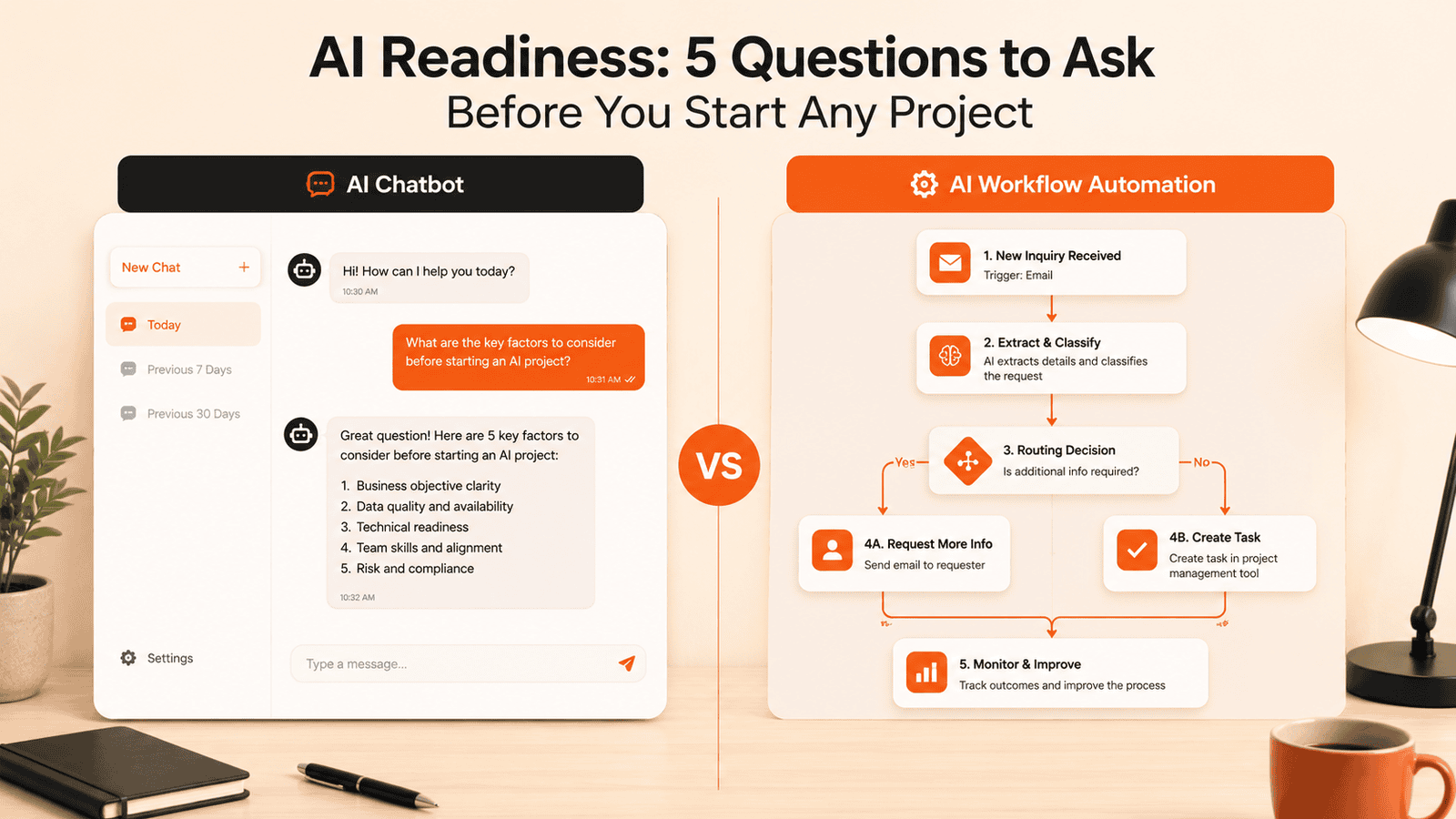


"Agent" has become a popular label, often applied to things that are really just chatbots. Here's the actual difference, and why the distinction matters more than marketing language suggests.
A Chatbot Responds; an Agent Acts
A traditional chatbot answers questions within a conversation. An agent is built to take multi-step actions on its own — checking a system, making a decision, and completing a task, not just replying. This distinction is about capability and autonomy, not conversational sophistication alone.
The Complexity Jump Is Real
Giving a system the ability to take actions, not just generate text, introduces genuine complexity around error handling, permissions, and what happens when something goes wrong mid-task. An agent that starts a multi-step process and fails partway through needs a defined recovery behavior that a simple conversational chatbot never has to consider.
Most Businesses Don't Need a Full Agent Yet
A well-designed chatbot with clean handoff to a human covers the majority of real support and service use cases. Agent-style automation earns its added complexity for genuinely multi-step, well-defined workflows, not simply because agent-based systems are currently generating more attention and interest.
How to Tell Which You Actually Need
If the task is "answer a question," you need a chatbot. If it's "complete a process across multiple systems without a human in the loop," that's agent territory — and worth scoping carefully given the added complexity and risk involved.
Trying to figure out which one actually fits your use case? AI Chatbots & Virtual Assistants
How Permission and Access Scope Should Be Designed for Agents
An agent with broad access to take actions across multiple systems carries meaningfully more risk than a chatbot that only generates text, which means permission scope needs deliberate, conservative design — granting only the specific access genuinely required for the agent's defined task, not broad system access by default.
Why Testing an Agent Requires a Different Approach Than Testing a Chatbot
Testing a chatbot largely means evaluating conversation quality. Testing an agent means validating actual outcomes across a range of scenarios, including failure scenarios, since an agent taking a wrong real-world action carries consequences a chatbot generating a wrong response simply doesn't.
The Role of Human Approval Checkpoints in Agent Design
Many production-ready agent systems build in explicit human approval checkpoints before consequential actions, rather than full autonomous execution from start to finish, striking a middle ground between full manual process and full automation that matches current real-world reliability levels for agent-based systems.
How Agent Reliability Compares to Chatbot Reliability Today
Current agent systems, while genuinely capable, still exhibit more unpredictable failure modes than well-designed conversational chatbots, particularly across longer, more complex multi-step tasks, which is part of why cautious, staged rollout matters more for agent-based systems than for simpler chatbot deployments.
Why the Terminology Itself Is Still Actively Evolving
The industry hasn't fully converged on precise definitions for these terms, and marketing language often applies "agent" loosely to systems that are functionally closer to sophisticated chatbots. Evaluating a vendor's actual described capability, rather than relying on which label they use, gives a more accurate picture of what you're actually considering.
A Reasonable Way to Start if Agent Capability Genuinely Interests You
Starting with a narrow, well-defined, lower-risk task — one with clear success criteria and limited consequence if something goes wrong — lets a team build real confidence and operational experience with agent-based automation before expanding to higher-stakes use cases.
How Agent Frameworks Have Evolved to Address Reliability Concerns
Newer agent frameworks increasingly build in structured validation steps between actions, rather than allowing fully unchecked autonomous execution, reflecting the industry's growing recognition that reliability, not just raw capability, determines whether agent-based systems are genuinely production-ready for a given use case.
This evolution toward more structured, checkpoint-based agent design represents a meaningful shift from earlier, more purely autonomous agent concepts that proved less reliable in genuine production use than initial enthusiasm suggested they would be.
Why Cost Considerations Differ Significantly Between Chatbots and Agents
An agent completing a multi-step task typically makes multiple underlying model calls to plan, execute, and verify each step, which means agent-based systems often carry meaningfully higher operating cost per completed task than a single-response chatbot interaction, a real factor worth including in any cost-benefit evaluation.
How to Think About Agent Autonomy as a Spectrum, Not a Binary
Rather than a strict chatbot-versus-agent binary, real systems exist along a spectrum of autonomy — from pure conversation, through suggested actions requiring explicit approval, to fully autonomous multi-step execution. Understanding where a specific use case genuinely needs to sit on this spectrum, rather than defaulting to either extreme, produces better-scoped systems.
What Genuine Agent Success Stories Currently Have in Common
The most successful current agent deployments tend to involve well-defined, bounded tasks with clear success criteria and reasonable tolerance for occasional human correction, rather than open-ended, high-stakes autonomous decision-making — a pattern worth learning from when scoping your own potential agent use case.
How to Explain This Distinction to Non-Technical Stakeholders
Describing a chatbot as "answering questions" and an agent as "getting things done" tends to communicate the practical distinction more clearly to non-technical stakeholders than technical language about autonomy or multi-step execution, which can help set appropriately different expectations for each type of system.
This simplified framing also helps stakeholders understand why an agent-based system genuinely warrants more careful review before deployment than a conversational chatbot would, since "getting things done" implies real-world consequences a stakeholder can intuitively grasp.
Key Takeaways
- A chatbot responds within conversation; an agent takes multi-step actions with real-world consequences.
- Agent capability introduces genuine complexity around error handling, permissions, and failure recovery.
- Most real support and service needs are well served by a well-designed chatbot, not full agent autonomy.
- Human approval checkpoints for consequential actions are a common, sensible middle ground in current agent design.
- Starting with a narrow, low-risk task builds operational confidence before expanding to higher-stakes agent use cases.
Frequently Asked Questions
Is an AI agent always more advanced or better than a chatbot?
Not necessarily — they're suited to different problems, and a well-designed chatbot can outperform a poorly scoped agent for tasks that don't genuinely need autonomous action.
Do agents require more oversight than chatbots?
Yes, generally — given the real-world consequences of autonomous action, more deliberate oversight and approval checkpoints are warranted for agent-based systems.
Can a chatbot be upgraded into an agent later?
Sometimes, though it usually requires meaningful additional design work around permissions, error handling, and testing, rather than a simple feature toggle.
What's the biggest risk of deploying an agent too early?
An agent taking an incorrect real-world action, with consequences beyond a simply wrong text response, which is why staged, cautious rollout matters more than for chatbots.
How do we evaluate a vendor claiming to offer "AI agents"?
Ask specifically what real-world actions the system can take autonomously, and what happens when something goes wrong, rather than relying on the label alone.
Is it reasonable to combine both a chatbot and agent capability in one system?
Yes — many practical systems use conversational chatbot capability for most interactions, escalating to more autonomous agent behavior only for specific, well-defined tasks.
Do agent systems cost more to run than chatbots for the same task?
Often yes — multi-step tasks typically require multiple underlying model calls to plan, execute, and verify, increasing cost per completed task.
Is autonomy really a binary choice between chatbot and full agent?
No — real systems exist along a spectrum, from pure conversation through approval-gated suggestions to fully autonomous execution.
What do successful current agent deployments tend to have in common?
Well-defined, bounded tasks with clear success criteria and reasonable tolerance for occasional human correction, rather than open-ended autonomy.
How should we explain this distinction to non-technical leadership?
Describing a chatbot as 'answering questions' and an agent as 'getting things done' communicates the practical distinction more clearly than technical language.
Does agent adoption vary significantly by industry?
Yes — industries with well-defined, repeatable processes tend to see faster agent adoption than those with highly variable, judgment-heavy workflows.
Should we pilot agent capability internally before any customer-facing use?
Yes — internal pilots let a team build confidence and catch failure modes in a lower-stakes setting before any customer-facing deployment.
Can an agent's decision-making process be made transparent for review?
Yes — well-designed agents can log their reasoning and each action taken, which is valuable for both debugging and building stakeholder trust.
Is agent adoption likely to accelerate significantly in the near future?
Reliability improvements suggest broader adoption is likely, though the pace will probably vary significantly by industry and specific use case.
Do agents need different monitoring tools than chatbots once deployed?
Yes — monitoring needs to track real-world action outcomes, not just conversation quality, requiring different tooling than typical chatbot analytics.
Will the chatbot-versus-agent distinction still matter in a few years?
Likely yes in some form — even as capability improves, the underlying distinction between conversation and consequential action will remain relevant to how systems are designed.