
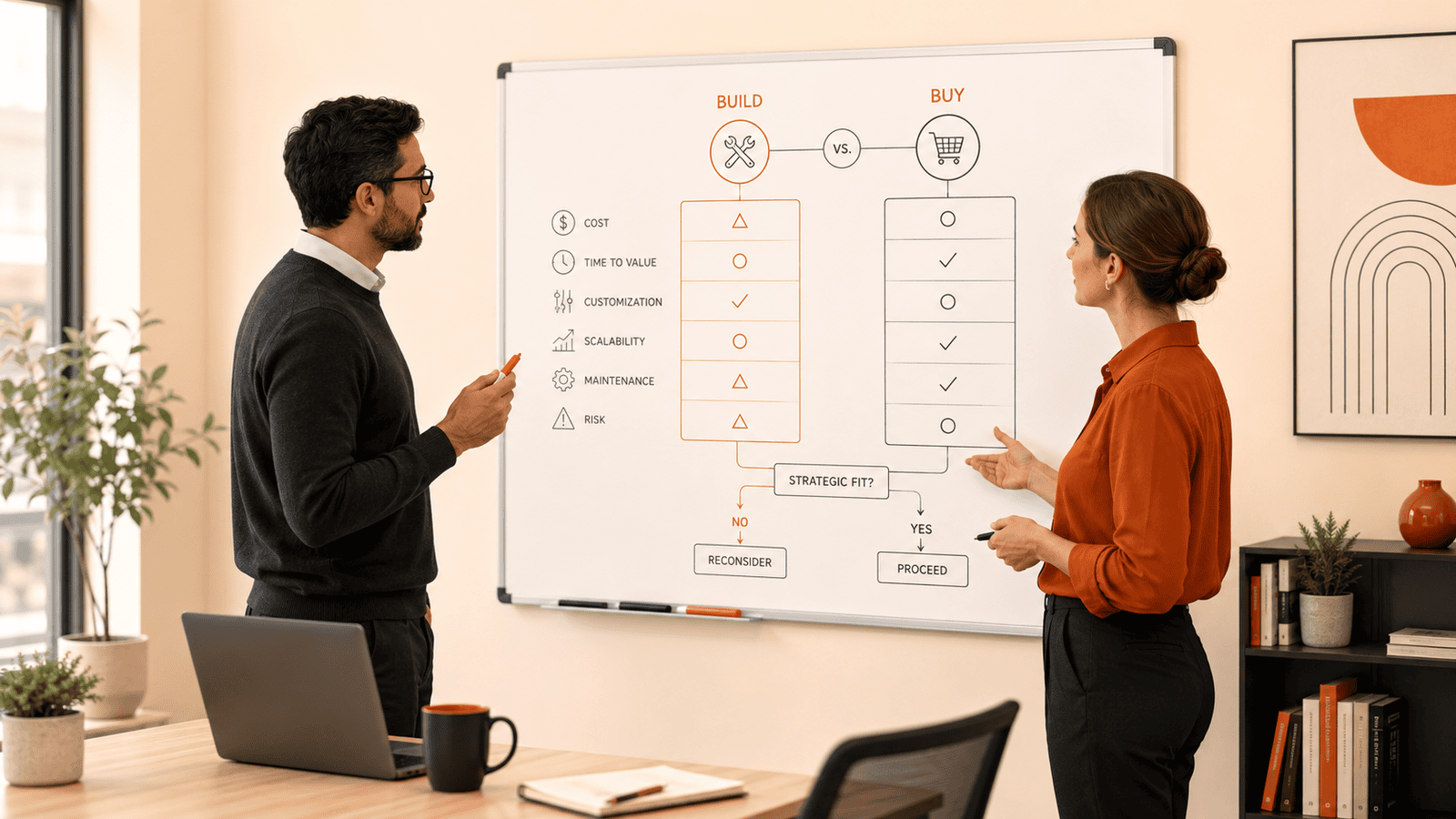
Build vs. buy shows up in every part of a growing business. Here's a framework that applies regardless of what you're deciding on, from a single feature to a full platform.
Start With Whether This Is Core to What Makes You Different
If the capability in question is genuinely part of your competitive advantage, building it — even at higher cost — often makes more sense than relying on something a competitor could license too. A capability that's genuinely differentiating loses much of its value if any competitor can access the exact same tool.
Factor In the Real Cost of Ongoing Ownership
Buying looks cheaper upfront but carries ongoing subscription costs and less control. Building costs more upfront but shifts the ongoing cost profile toward maintenance you control directly. Neither is universally cheaper — the honest comparison requires projecting both paths over a multi-year horizon, not just comparing initial cost.
Consider How Fast the Category Is Changing
In fast-moving categories, buying can be the safer choice, since a vendor's dedicated team may keep pace with change better than an internal team with other priorities. Conversely, in a stable, well-understood category, the risk of a vendor falling behind or discontinuing a product is lower, which shifts the calculation somewhat toward building if other factors favor it.
Assess Integration Complexity Honestly
A bought solution that needs extensive custom integration work to fit your existing systems can end up costing nearly as much as building, while still carrying the ongoing licensing cost and less flexibility. It's worth honestly estimating integration effort as part of the buy-side cost, not just the sticker price of the software itself.
Weighing a build-vs-buy decision for something specific? Custom Web Application Development
The Decision Isn't Always Permanent
It's reasonable to buy now and build later once a capability proves valuable enough to justify the investment — treating the decision as reversible reduces the pressure to get it perfectly right immediately. Starting with a bought solution to validate real demand before committing to a custom build is often a lower-risk path than building first on an unproven assumption.
How Team Capacity Should Factor Into the Decision
Building internally requires ongoing engineering capacity not just for the initial build but for years of subsequent maintenance, and that capacity has a real opportunity cost — time spent maintaining a non-core internal tool is time not spent on whatever else that team could be working on. This opportunity cost is easy to underweight in an initial build-vs-buy analysis that focuses mainly on direct dollar cost comparison.
A team already stretched thin on core product work is a weaker candidate for taking on additional internal build-and-maintain responsibility, regardless of how the raw cost comparison looks on paper.
A Practical Decision Checklist
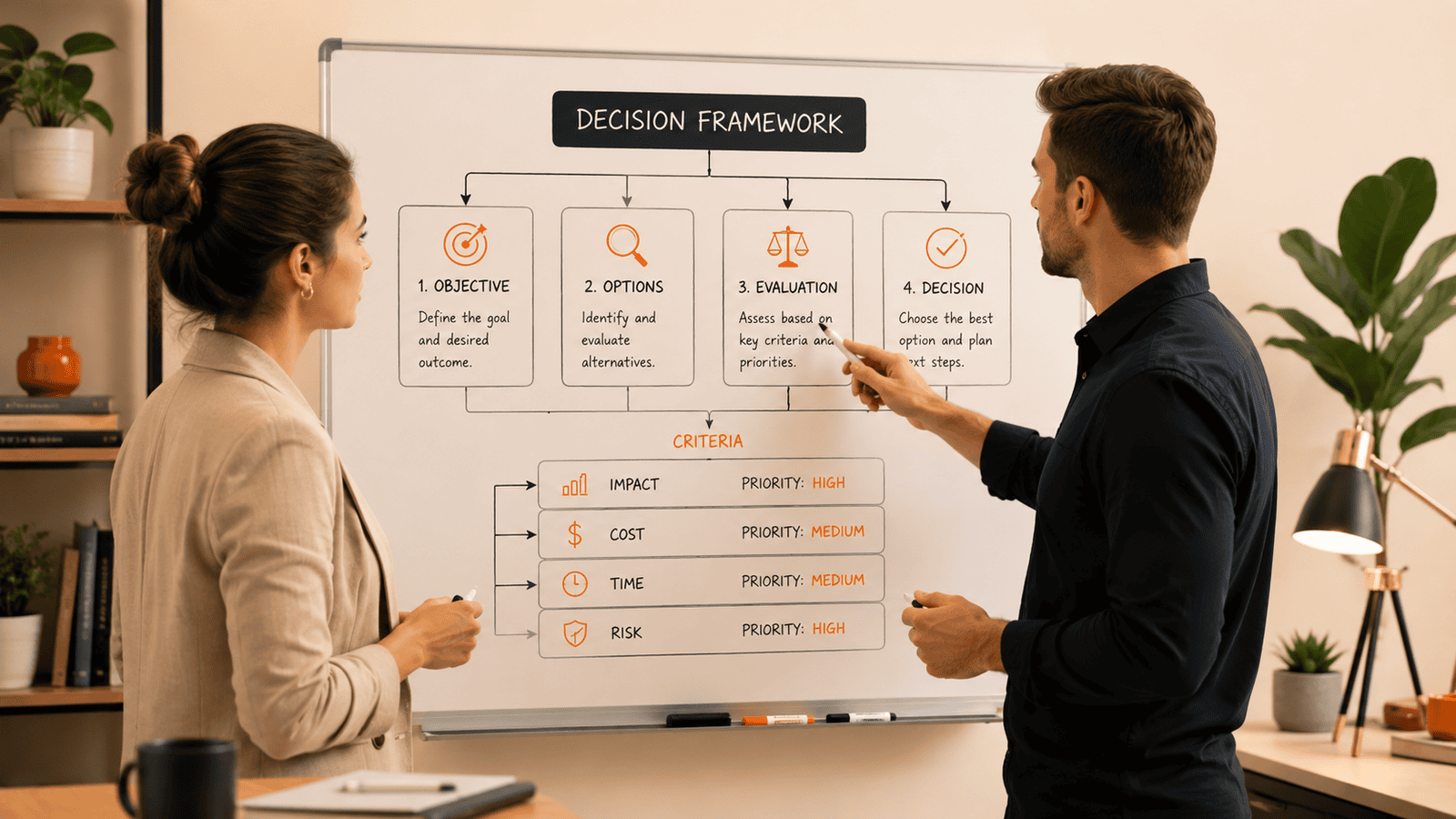
Before finalizing a build-vs-buy decision, it's worth explicitly answering a short list of questions: is this genuinely core to what differentiates us, what's the realistic multi-year cost of each path including maintenance, how fast is this category evolving, what's the actual integration burden either way, and does our team have real capacity to own this long-term if we build it. A decision that holds up against all five tends to be more durable than one made quickly on cost alone.
How Vendor Lock-In Should Factor Into a Buy Decision
Choosing to buy doesn't just mean an ongoing subscription cost — it often means real dependency on that vendor's roadmap, pricing decisions, and continued existence. A vendor that gets acquired or shifts strategic focus can leave you scrambling, which is worth weighing honestly against the convenience of not having to build and maintain something yourself.
Evaluating how easily your data and workflows could migrate away from a given vendor, before you're deeply dependent on them, is a reasonable part of any buy decision for something business-critical.
A Real Example of the Framework in Practice
Consider a company deciding whether to build custom inventory forecasting or buy an existing tool. If forecasting accuracy is genuinely core to their competitive advantage, and their category is stable enough that a custom model won't need constant re-architecture, building may make sense despite the higher upfront cost. If forecasting is important but not differentiating, and off-the-shelf tools already handle their specific product categories well, buying is very likely the more sensible path.
How to Present This Framework to Non-Technical Stakeholders
Leadership without a technical background often defaults to whichever option sounds cheaper upfront, missing the multi-year cost and strategic differentiation dimensions entirely. Presenting the framework visually — a simple table comparing each factor side by side — tends to produce a more informed decision than a purely verbal pitch for one option over the other.
What Happens When Different Stakeholders Disagree
It's common for a technical team to favor building, driven by a genuine desire to own the solution, while finance favors buying for its predictable cost. Walking through each of the five framework questions explicitly and openly, rather than letting the decision become a proxy battle between departments, tends to produce a more durable, broadly supported outcome.
How to Revisit a Build-vs-Buy Decision Periodically
A decision made two years ago under one set of market conditions may no longer be the right call as your business and the available options both evolve. Revisiting major build-vs-buy decisions on an annual basis, rather than treating them as permanently settled, keeps the choice aligned with current reality rather than outdated assumptions.
Why This Framework Applies Beyond Software Specifically
The same five questions — core differentiation, multi-year cost, category change speed, integration burden, and team capacity — apply reasonably well to decisions beyond software, from choosing a marketing agency versus an in-house team to outsourcing versus building internal expertise in any function.
A Common Mistake: Deciding Based on Sunk Cost
Teams that have already invested significant time in a partial internal build sometimes continue building past the point where buying would now be the better choice, purely because of what's already been invested. Evaluating the decision fresh, based on the path forward rather than what's already been spent, produces a more rational outcome.
Key Takeaways
- Capabilities genuinely core to your competitive advantage more often justify building, even at higher upfront cost.
- Compare ongoing ownership cost over multiple years, not just initial price, between build and buy options.
- Fast-changing categories often favor buying; stable, well-understood categories shift the calculation toward building.
- Integration effort for a bought solution should be honestly estimated as part of its real total cost.
Frequently Asked Questions
Is it ever reasonable to change our mind after choosing build or buy?
Yes — treating the initial decision as reversible, and starting with the lower-risk option to validate demand, is often smarter than trying to get a permanent decision perfectly right upfront.
How do we estimate the true multi-year cost of buying a solution?
Project subscription costs forward, add realistic integration and internal management time, and compare that total against a realistic build-and-maintain estimate over the same period.
Does company size affect this decision?
Yes — smaller companies often lack the resources to build and maintain custom software for non-core capabilities, which shifts the practical calculation toward buying more often.
How much does team capacity actually matter in this decision?
Significantly — building requires ongoing maintenance capacity with a real opportunity cost, which is easy to underweight if the analysis focuses mainly on direct dollar comparison.
Is there a simple checklist to work through before deciding?
Yes — core differentiation, realistic multi-year cost, category change speed, integration burden, and team capacity to maintain it long-term are the five questions worth answering explicitly.
How much should vendor lock-in worry us when buying software?
It's worth evaluating seriously for anything business-critical — understanding how easily you could migrate away from a vendor before you're deeply dependent reduces real long-term risk.
Can you walk through a concrete build-vs-buy example?
For something like inventory forecasting, the decision hinges on whether accuracy is genuinely core to your competitive advantage versus just generally useful, which tips the framework toward building or buying respectively.
How do we present this decision clearly to non-technical stakeholders?
A simple visual comparison table walking through each framework factor tends to produce a more informed decision than a purely verbal pitch.
What if different departments disagree on build versus buy?
Walking through the five framework questions explicitly and openly, rather than letting the decision become a departmental proxy battle, produces a more durable outcome.
Should we revisit a build-vs-buy decision after it's been made?
Yes — revisiting major decisions annually keeps them aligned with current market conditions rather than outdated assumptions from when the original choice was made.
Does this framework apply outside of software decisions?
Yes — the same five questions apply reasonably well to decisions like in-house versus outsourced expertise in other business functions.
Does company culture affect whether build or buy tends to work better?
Yes — organizations with strong internal engineering culture tend to execute builds more successfully than those without, which is worth factoring into the decision honestly.
Should startups lean more toward buying than established companies?
Generally yes — startups typically benefit from conserving engineering capacity for their core differentiating product rather than building supporting infrastructure themselves.