
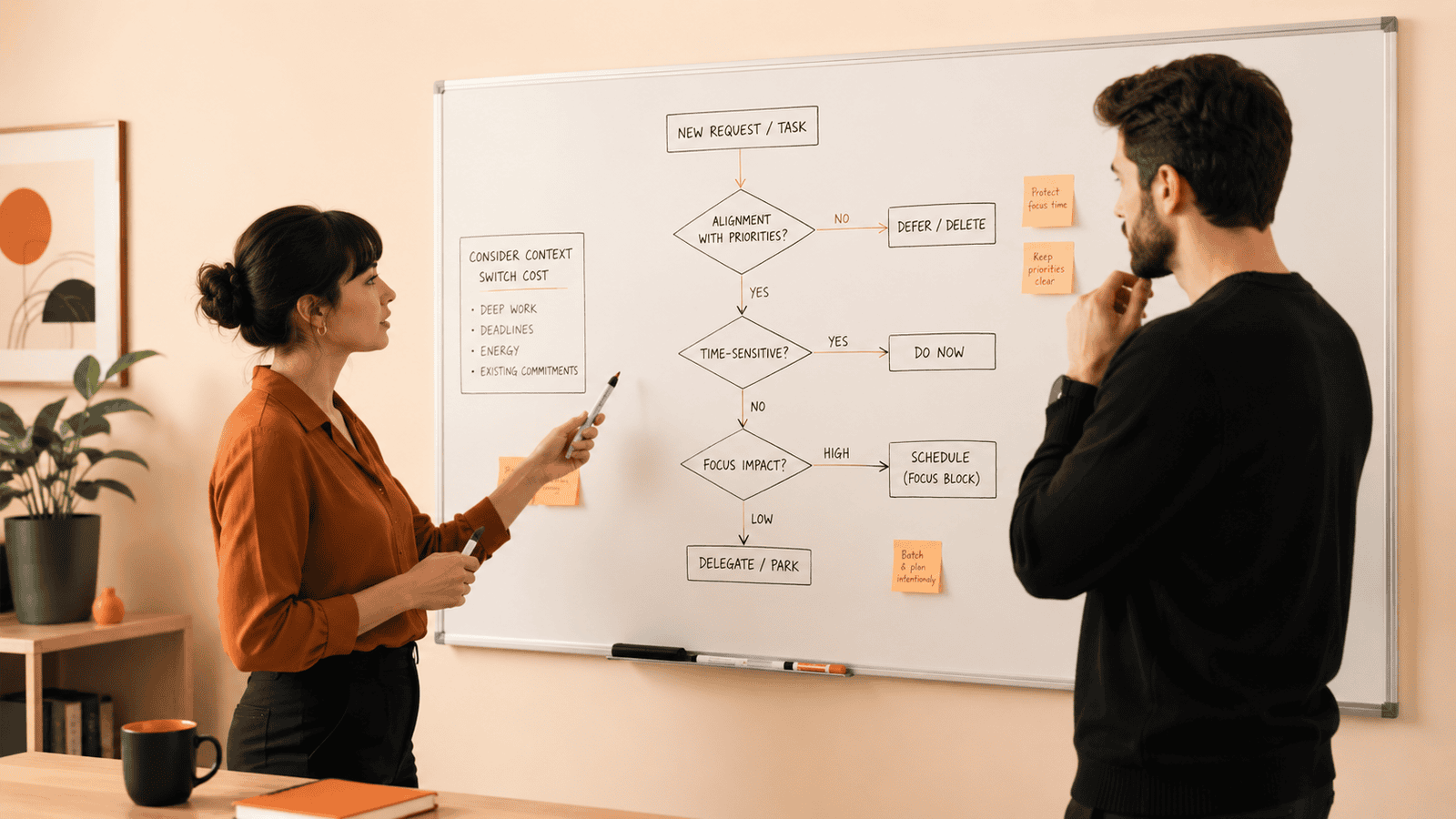
Constant interruptions feel like minor productivity drags. The actual cost, measured properly, is considerably larger than most teams intuitively assume.
Deep Work Takes Real Time to Rebuild After Interruption
Returning to complex technical work after an interruption isn't instant — it takes genuine time to rebuild the mental context that was lost, meaning a five-minute interruption often costs considerably more than five minutes of actual lost productivity.
Meeting Culture Often Fragments the Day Beyond Recognition
A day broken into small chunks between scheduled meetings leaves little genuine room for the sustained focus complex development work actually requires, regardless of how efficient each individual meeting itself might be.
Slack and Chat Tools Create Their Own Constant Interruption Pattern
The expectation of near-instant response to messages fragments attention throughout the day in a way that's easy to underestimate, since each individual interruption feels small while the cumulative effect compounds considerably over a full working day.
What Actually Helps
Protected blocks of genuinely uninterrupted time, and cultural norms around asynchronous communication rather than expecting instant response, measurably improve both output quality and developer satisfaction with their work.
Want a development process that genuinely protects deep work time? Custom Web Application Development
How to Measure Context Switching Cost Concretely for Your Own Team
Tracking actual meeting time and interruption frequency against genuine output over a representative period gives concrete data to evaluate whether your team's current interruption pattern is genuinely costing as much as this topic suggests, rather than relying on abstract argument alone.
Teams that run this kind of honest measurement often discover the actual cost is higher than intuition suggested, since the compounding effect of frequent small interruptions is genuinely difficult to estimate accurately without concrete tracking data behind it.
Why Meeting-Free Blocks Need Genuine Protection, Not Just Good Intentions
A nominally protected focus block that gets routinely overridden for "quick" meetings provides little real protection — genuine protection requires actual organizational discipline treating these blocks as truly non-negotiable, not merely a default that yields under any scheduling pressure.
How Notification Settings Should Be Deliberately Configured, Not Left Default
Default notification settings on most communication tools are configured for maximum immediate visibility, not for genuinely protecting focus, making deliberate reconfiguration toward batched, less immediate notification delivery a worthwhile individual and team-level practice.
Why Some Roles Genuinely Need More Interruption Tolerance Than Others
Not every role benefits equally from protected deep work blocks — roles genuinely centered around real-time collaboration and quick response naturally have different interruption tolerance than roles centered around sustained individual technical work.
A Reasonable Way to Introduce Protected Focus Time to a Resistant Team Culture
Starting with a modest, clearly time-boxed pilot \— a few protected hours on specific days \— and measuring genuine results before expanding builds a more persuasive internal case than an abrupt, comprehensive culture change attempted all at once.
How Open-Plan Offices Compound the Interruption Problem
Physical open-office layouts, designed to encourage collaboration, often inadvertently increase ambient noise and visual distraction that further fragments sustained focus, adding a physical dimension to the interruption problem beyond purely digital and meeting-based sources.
Teams working in genuinely open layouts benefit from deliberately designated quiet zones or scheduled quiet hours, since the collaborative benefit open layouts are meant to provide doesn't have to come at the complete expense of protected individual focus time.
Why Pair Programming Sessions Should Be Treated Differently From Interruptions
Deliberate, scheduled collaborative work like pair programming isn't genuinely an interruption in the same sense as an unplanned message or meeting, since both participants enter with shared context and intention, making this an important distinction when designing interruption-reduction policies.
How Remote Work Has Changed the Nature of This Problem
Remote work has reduced some interruption sources like walk-up questions while introducing others, like the expectation of near-constant chat availability, meaning the overall interruption calculus has shifted rather than simply improved or worsened uniformly across the board.
Why Manager Behavior Sets the Real Tone More Than Written Policy
A written focus-time policy that managers themselves don't respect through their own scheduling and communication behavior carries little real weight — genuine cultural change requires visible leadership modeling of the behavior the policy is meant to establish.
A Reasonable Way to Balance Genuine Collaboration Needs With Focus Protection
Designating specific, predictable windows for collaborative work and meetings, with the remaining time genuinely protected for individual focus, gives a team both genuine collaboration opportunity and meaningful uninterrupted work time, rather than treating the two needs as inherently opposed.
How to Communicate the Real Cost of Interruptions to Non-Technical Leadership
Framing context-switching cost in terms of concrete missed deadlines and delayed feature delivery, rather than abstract productivity theory, helps non-technical leadership genuinely understand why protecting focus time deserves real organizational priority.
Why Junior Developers Are Often More Vulnerable to Interruption Cost Than Senior Ones
Less experienced developers often take longer to rebuild context after an interruption, since experienced developers have built more efficient mental models for quickly reorienting, making focus protection genuinely more valuable, not less, for newer team members specifically.
Why Some Companies Have Adopted "No-Meeting Days" With Real Success
Designating specific full days each week with no internally scheduled meetings gives developers reliably predictable stretches of protected time, an approach some companies have adopted with genuine measurable success in both output and reported developer satisfaction.
How to Handle Genuinely Urgent Interruptions Within a Focus-Protected Culture
Even the most protected focus culture needs a clear, narrow exception path for genuinely urgent issues, defined specifically enough that it doesn't become a loophole undermining the broader protection the policy is meant to establish.
Key Takeaways
- Returning to complex work after interruption takes genuine time to rebuild context, costing more than the interruption itself.
- Fragmented days between scheduled meetings leave little genuine room for sustained focus complex work requires.
- Constant messaging response expectations compound into significant cumulative interruption cost over a full day.
- Protected, genuinely uninterrupted time blocks measurably improve both output quality and developer satisfaction.
- Concrete measurement of actual interruption cost often reveals a higher true impact than intuition alone suggests.
Frequently Asked Questions
How much time does a typical interruption actually cost beyond its own duration?
Research suggests rebuilding lost mental context after an interruption often takes considerably longer than the interruption itself, though the exact amount varies by task complexity.
Should all roles have equally protected focus time?
Not necessarily — roles centered around real-time collaboration naturally have different interruption tolerance than roles centered around sustained individual work.
How do we measure whether context switching is genuinely costing our team?
Tracking actual meeting time and interruption frequency against genuine output over a representative period reveals real, concrete impact.
Is it realistic to eliminate interruptions entirely?
No, and that's not the goal — the goal is protecting meaningful blocks of genuinely uninterrupted time, not eliminating all collaboration.
What's a reasonable first step to introduce protected focus time?
A modest, time-boxed pilot with a few protected hours, measured before expanding, builds a more persuasive case than abrupt full change.
Do open-plan offices make context switching worse?
Yes, often — ambient noise and visual distraction add a physical dimension to the interruption problem beyond digital sources.
Should pair programming be treated as an interruption?
No — deliberate, scheduled collaborative work with shared context and intention differs meaningfully from unplanned interruptions.
Has remote work made this problem better or worse overall?
Neither uniformly — it reduced some interruption sources while introducing others like constant chat availability expectations.
Does manager behavior really matter for interruption policy success?
Yes significantly — a policy managers don't respect through their own behavior carries little real cultural weight.
How do we communicate interruption cost to non-technical leadership?
Framing it in terms of concrete missed deadlines and delayed delivery helps leadership understand why it deserves real priority.
Are junior developers more vulnerable to context-switching cost?
Often yes — they typically take longer to rebuild context, making focus protection genuinely more valuable for newer team members.
Do 'no-meeting days' actually work in practice?
Yes, with reported success at companies that have adopted them, giving developers reliably predictable protected time.
How do we handle genuinely urgent interruptions in a focus-protected culture?
A clear, narrowly defined exception path prevents it from becoming a loophole undermining the broader protection.
Does context switching cost apply to non-development roles too?
Yes — any role requiring sustained focus for complex tasks faces similar costs, though the specific impact varies by role.
Should we measure interruption cost per individual or per team?
Team-level patterns are usually more actionable, though individual variation is also worth understanding for personalized approaches.
Can tools that batch notifications actually help reduce interruption cost?
Yes — batching notifications into scheduled intervals rather than instant delivery reduces the frequency of genuine interruption.
Does this problem worsen as a team grows larger?
Often yes — more people typically means more meetings and coordination overhead, making focus protection more important as teams scale.
Is calendar blocking an effective way to protect focus time?
Yes, when genuinely respected — blocking time on a shared calendar signals unavailability clearly to colleagues scheduling meetings.